Patient Capital Quarterly Commentary – Q2 2026

Market Review

Financial markets delivered strong results in the first half of 2026. Equities sold off sharply in the first quarter following the outbreak of the U.S.–Iran war in late February, then rebounded strongly in the second quarter as tensions in the Middle East eased and enthusiasm returned over the growth potential of artificial intelligence. The S&P 500 Index finished the first half with a total return of 10.2%.1

The S&P/TSX Composite Total Return Index rose 11.16% over the same period,2 with energy, financials, and utilities each posting double-digit gains. Canada’s heavy weighting in energy and materials proved an advantage in a period defined by elevated commodity prices.

Economic Backdrop

The U.S. economy remained resilient. Real GDP grew at an annual rate of 2.1% in the first quarter,3 a marked acceleration from 0.5% in the fourth quarter of 2025.4 Job growth remained steady, and the unemployment rate stood at 4.2%.5

The Canadian economy continued its slow adjustment to U.S. tariffs and trade uncertainty. After contracting in the fourth quarter of 2025, growth resumed in early 2026. The labour market remained soft, however, with the unemployment rate holding in the 6.5%–7% range.6

Valuations and the Outlook for Returns

The table below highlights the returns that equity markets would need to generate in order to return to a normalized equity return of 7.5% following several years of above-average performance. In short, based on the assumptions underlying the table below, returns over the next five- and ten-year periods could be lower than those of the recent past. Alternatively, based on the same assumptions, the table suggests that markets would need to decline from current levels to restore the normalized rate over a shorter horizon.

Future TSX Total Return Required for Reversion to Long-Term Average 7.5% Return

Assumptions used: Current TSX Total Return Index level = 148,898.98 as of May 31, 2026; long-term annualized target return = 7.5%; all stated return figures are treated as annualized. 
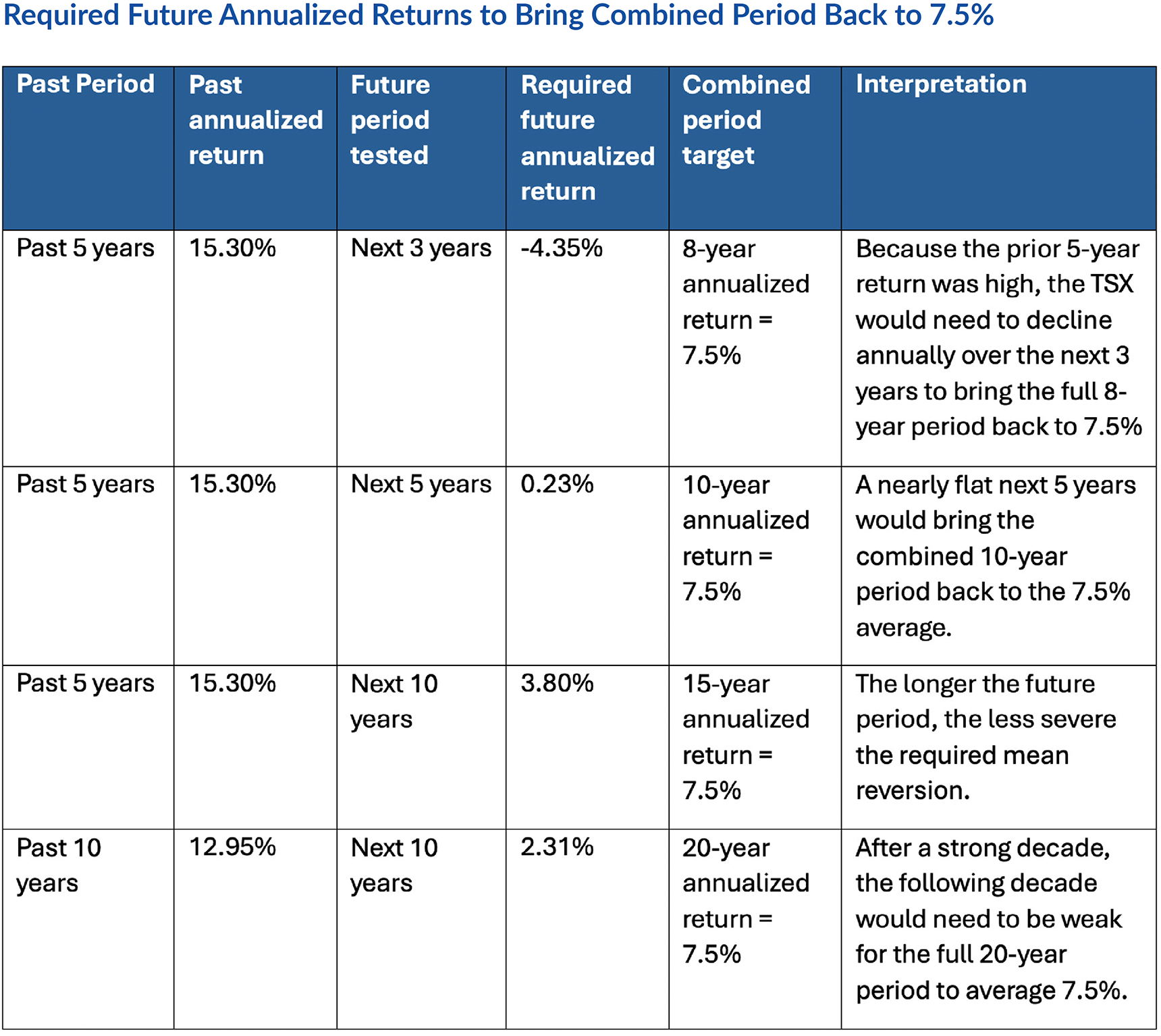
Required Future Annualized Returns to Bring Combined Period back to 7.5%
Key Takeaway: The TSX Total Return Index has materially exceeded its 7.5% long-term average over the recent trailing periods discussed. In order to get back to its long-term average, the TSX would have to post substantially below average returns over the next three-, five-, and ten-year periods.
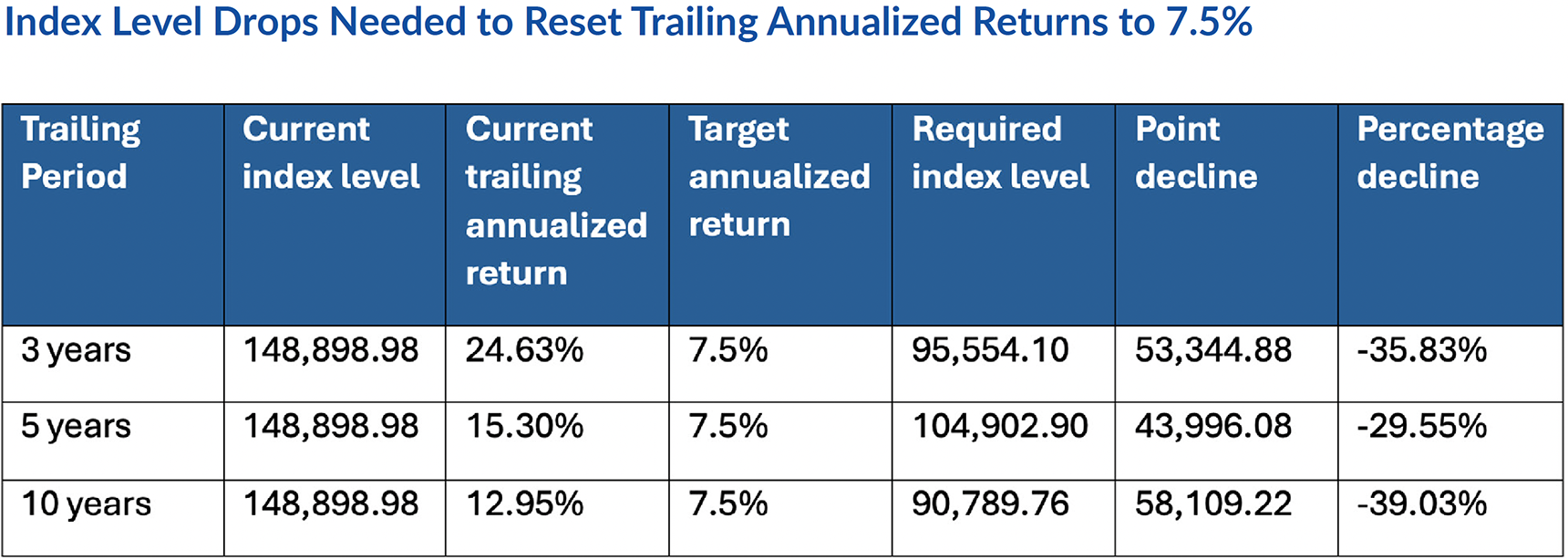
Index Level Drops Needed to Reset Trailing Annualized Returns to 7.5%
Key takeaway: The TSX Total Return Index has materially exceeded its 7.5% long-term average over the recent trailing periods discussed. To reset the trailing 3-, 5-, or 10-year annualized returns back to 7.5% immediately, the required one-time decline would range from roughly 30% to 39%, depending on the measurement period.
Source: S&P Global

Historically, after extended periods of strong equity market performance culminating in extreme valuations, long-term value-based investment strategies have outperformed equity indices on both an absolute and a relative basis. If future growth falls below expectations and equity market returns normalize, investors may once again focus on quality businesses—those generating sustainable profits and cash flows—trading at reasonable valuations.

Portfolio Positioning

In our view, Lysander-Patient Capital Equity Fund (the “Fund”) continues to be well positioned for current market conditions. As of June 30, 2026, the dividend yield on the Fund’s equity holdings was 5.06%, and the total portfolio yield was 4.34%. The portfolio’s overall characteristics also compare favourably to major benchmarks such as the S&P 500 Index and the S&P/TSX Composite Total Return Index. We believe the Fund’s value-based investment philosophy will serve investors well as market returns normalize and valuations revert to historical means.


  1. Source: S&P Dow Jones Indices.
  2. Source: S&P/TSX.
  3. Source: U.S. Bureau of Economic Analysis.
  4. Source: U.S. Bureau of Economic Analysis.
  5. Source: U.S. Bureau of Labor Statistics.
  6. Source: Statistics Canada.

Lysander Funds Limited (“Lysander”) is the investment fund manager of Lysander-Patient Capital Equity Fund (the “Fund”). Patient Capital Management Inc. (“Patient Capital”) is the portfolio manager of the Fund. This document was prepared by Patient Capital as portfolio manager of the Fund. In this presentation, “we”, “us”, and “our” means Patient Capital. This document has been prepared solely for information purposes. Information in this document is not intended to constitute legal, tax, securities or investment advice and is made available on an “as is" basis. Neither Lysander nor Patient Capital make any warranties or representations regarding the information herein. Information in this document is subject to change without notice. Neither Lysander nor Patient Capital assume any duty to update any information herein. Certain information in this document has been derived or obtained from sources believed to be trustworthy and/or reliable. Neither Lysander nor Patient Capital assume responsibility for the accuracy, currency, reliability or correctness of any such information.

Commissions, trailing commissions, management fees and expenses all may be associated with mutual fund investments. Please read the prospectus before investing. Mutual funds are not guaranteed, their values change frequently, and past performance may not be repeated

This document is not an invitation to invest in the Fund and does not constitute a public offering of sale. Purchases in the Fund can only be made through an Investment Professional on the terms in the applicable Fund’s offering document by eligible investors. Each purchaser of units in a fund may have statutory or contractual right of action.

This document may contain forward-looking statements. Statements concerning a Fund’s or entity’s objectives, goals, strategies, intentions, plans, beliefs, expectations and estimates, and the business, operations, financial performance and condition are forward looking statements. The words “believe”, “expect”, “anticipate”, “estimate”, “intend”, “aims”, “may”, “will”, “would” and similar expressions and the negative of such expressions are intended to identify forward-looking statements, although not all forward-looking statements contain these identifying words. These forward-looking statements are subject to various risks and uncertainties that could cause actual results to differ materially from current expectations. Readers are cautioned not to place undue reliance on these forward-looking statements. While Lysander and Patient Capital consider these risks and uncertainties to be reasonable based on information currently available, they may prove to be incorrect.

Nothing in this document should be considered a recommendation to buy, sell or short a particular security. Any specific securities or positions discussed are intended as an illustration of the portfolio manager’s selection process. The portfolio manager may sell these positions at any time, or purchase positions that have previously been sold. The positions may increase or decrease in value after the date hereof, and the portfolio that holds such positions may accordingly gain or lose money on the investment. The statements by the portfolio manager in its commentaries are intended to illustrate its approach in managing the portfolio and should not be relied upon for any other purpose. Certain information in this document has been derived or obtained from sources believed to be trustworthy and/or reliable. Neither Lysander nor Patient Capital assume responsibility for the accuracy, currency, reliability or correctness of any such information.

The S&P/TSX Composite Total Return Index is comprised of equity securities of some of the largest companies in Canada. The S&P 500 Index tracks the stock performance of 500 large companies listed on exchanges in the United States. An investor cannot invest directly in an index.

®Lysander Funds is a registered trademark of Lysander Funds Limited.