Market Review
Financial markets delivered strong results in the first half of 2026. Equities sold off sharply in the first quarter following the outbreak of the U.S.–Iran war in late February, then rebounded strongly in the second quarter as tensions in the Middle East eased and enthusiasm returned over the growth potential of artificial intelligence. The S&P 500 Index finished the first half with a total return of 10.2%.1
The S&P/TSX Composite Total Return Index rose 11.16% over the same period,2 with energy, financials, and utilities each posting double-digit gains. Canada’s heavy weighting in energy and materials proved an advantage in a period defined by elevated commodity prices.
Economic Backdrop
The U.S. economy remained resilient. Real GDP grew at an annual rate of 2.1% in the first quarter,3 a marked acceleration from 0.5% in the fourth quarter of 2025.4 Job growth remained steady, and the unemployment rate stood at 4.2%.5
The Canadian economy continued its slow adjustment to U.S. tariffs and trade uncertainty. After contracting in the fourth quarter of 2025, growth resumed in early 2026. The labour market remained soft, however, with the unemployment rate holding in the 6.5%–7% range.6
Valuations and the Outlook for Returns
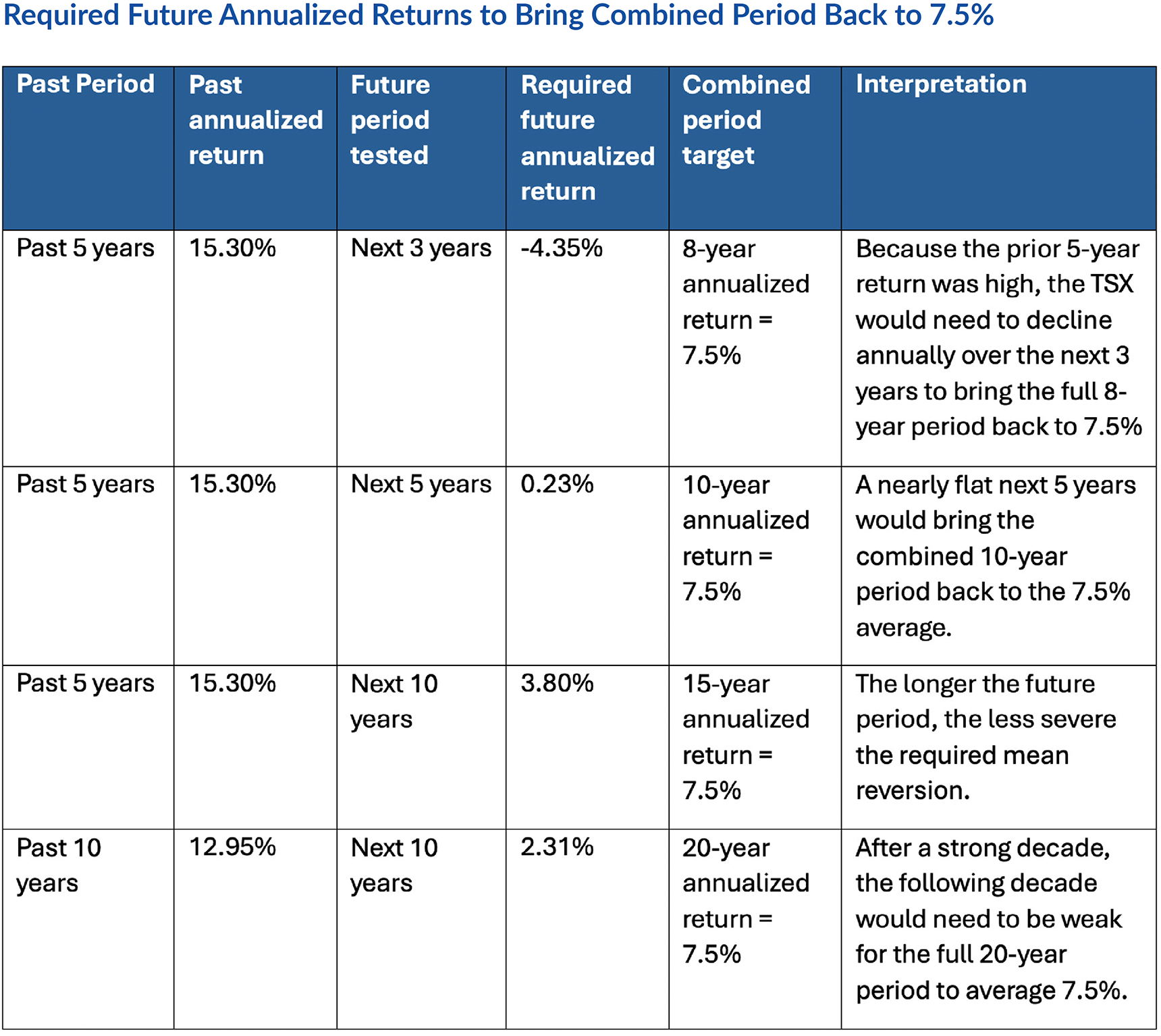
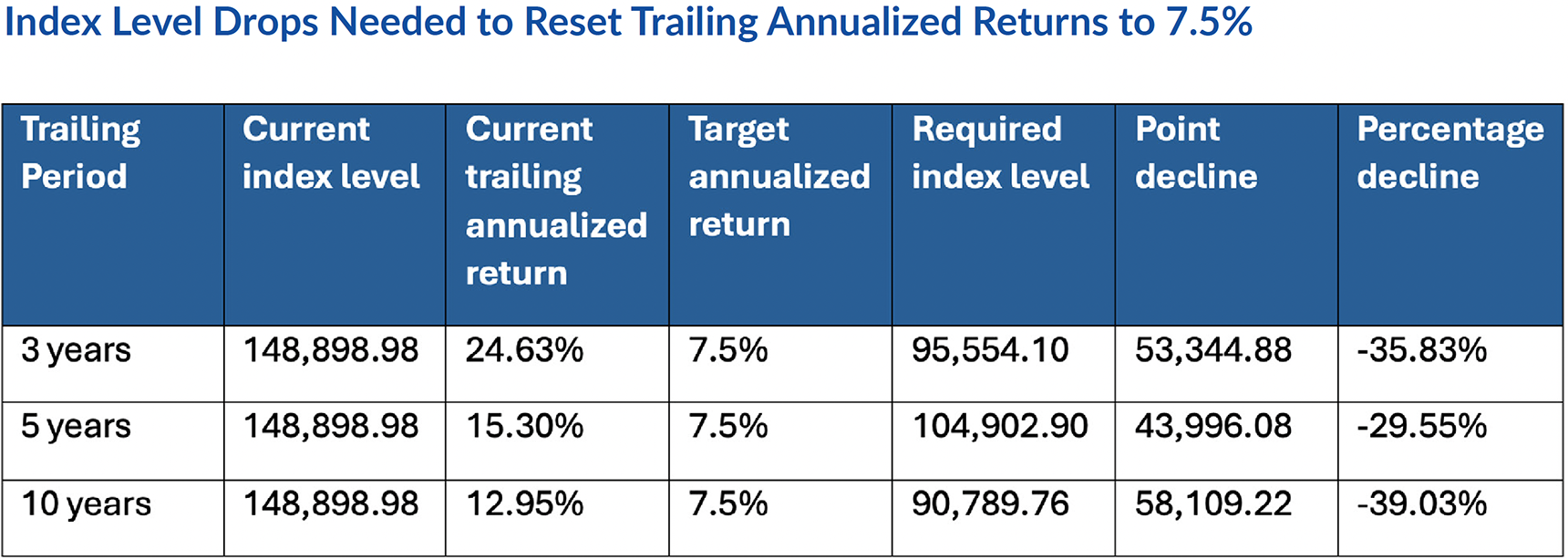
The table below highlights the returns that equity markets would need to generate in order to return to a normalized equity return of 7.5% following several years of above-average performance. In short, based on the assumptions underlying the table below, returns over the next five- and ten-year periods could be lower than those of the recent past. Alternatively, based on the same assumptions, the table suggests that markets would need to decline from current levels to restore the normalized rate over a shorter horizon.
Future TSX Total Return Required for Reversion to Long-Term Average 7.5% Return
Assumptions used: Current TSX Total Return Index level = 148,898.98 as of May 31, 2026; long-term annualized target return = 7.5%; all stated return figures are treated as annualized.
Source: S&P Global
Historically, after extended periods of strong equity market performance culminating in extreme valuations, long-term value-based investment strategies have outperformed equity indices on both an absolute and a relative basis. If future growth falls below expectations and equity market returns normalize, investors may once again focus on quality businesses—those generating sustainable profits and cash flows—trading at reasonable valuations.
Portfolio Positioning
In our view, Lysander-Patient Capital Equity Fund (the “Fund”) continues to be well positioned for current market conditions. As of June 30, 2026, the dividend yield on the Fund’s equity holdings was 5.06%, and the total portfolio yield was 4.34%. The portfolio’s overall characteristics also compare favourably to major benchmarks such as the S&P 500 Index and the S&P/TSX Composite Total Return Index. We believe the Fund’s value-based investment philosophy will serve investors well as market returns normalize and valuations revert to historical means.
- Source: S&P Dow Jones Indices.
- Source: S&P/TSX.
- Source: U.S. Bureau of Economic Analysis.
- Source: U.S. Bureau of Economic Analysis.
- Source: U.S. Bureau of Labor Statistics.
- Source: Statistics Canada.