

“Whoever wins AI, wins”
In John Keynes’ 1936 best seller, The General Theory of Employment, Interest and Money, he talked about animal spirits. He described it as a:
“spontaneous urge to action rather than inaction.”1
According to Keynes, a large part of humanity’s positive activities, whose returns are expected over the long-term, depends on optimism rather than on a simple mathematical expectation. The present-day Artificial Intelligence (AI) build-out reminds us of rampant animal spirits. We know that things have gone overboard when we hear the Anthropic CEO say,
“whoever wins AI, wins.”2
The AI investment is expected to be the largest sectoral investment in the U.S., surpassing other major projects such as the fibre network for internet and railroads. It is primarily being funded by debt and led by hyperscalers such as Alphabet, Microsoft, Amazon and Meta. Hyperscalers provide cloud computing and data management services to organizations that require large-scale data processing and storage.
We have identified over US$3 trillion of spending by hyperscalers on leases and purchase commitments. These companies are using complex structures and off-balance sheet arrangements to raise funds. Nvidia, who supplies chips to be used in AI data centres, is engaged in vendor financing in exchange for customers buying more of their chips. They are extending loans or outright buying equity of their customers like Anthropic and OpenAI. This reminds us of an older time when we would discuss vendor financing at Nortel Networks. Nortel sold their equipment on credit to very weak telecom services companies, who didn’t have the wherewithal to pay upfront. Even as Nortel booked revenues on selling its products, it also created account receivables, that kept creeping higher. Eventually, Nortel had to write-off much of their account receivables and extending credit to buyers quickly unravelled.
We have pointed out that much of the lease liabilities are not reflected on the balance sheet of hyperscalers. This is because the data centre is not up and running. Lease payment obligations would appear on the balance sheets of the technology companies once the lease starts, along with a corresponding right-of-use asset. Meanwhile, the legally binding lease obligations for purchase commitments to buy chips, equipment etc. are relegated to the footnotes of the financials.
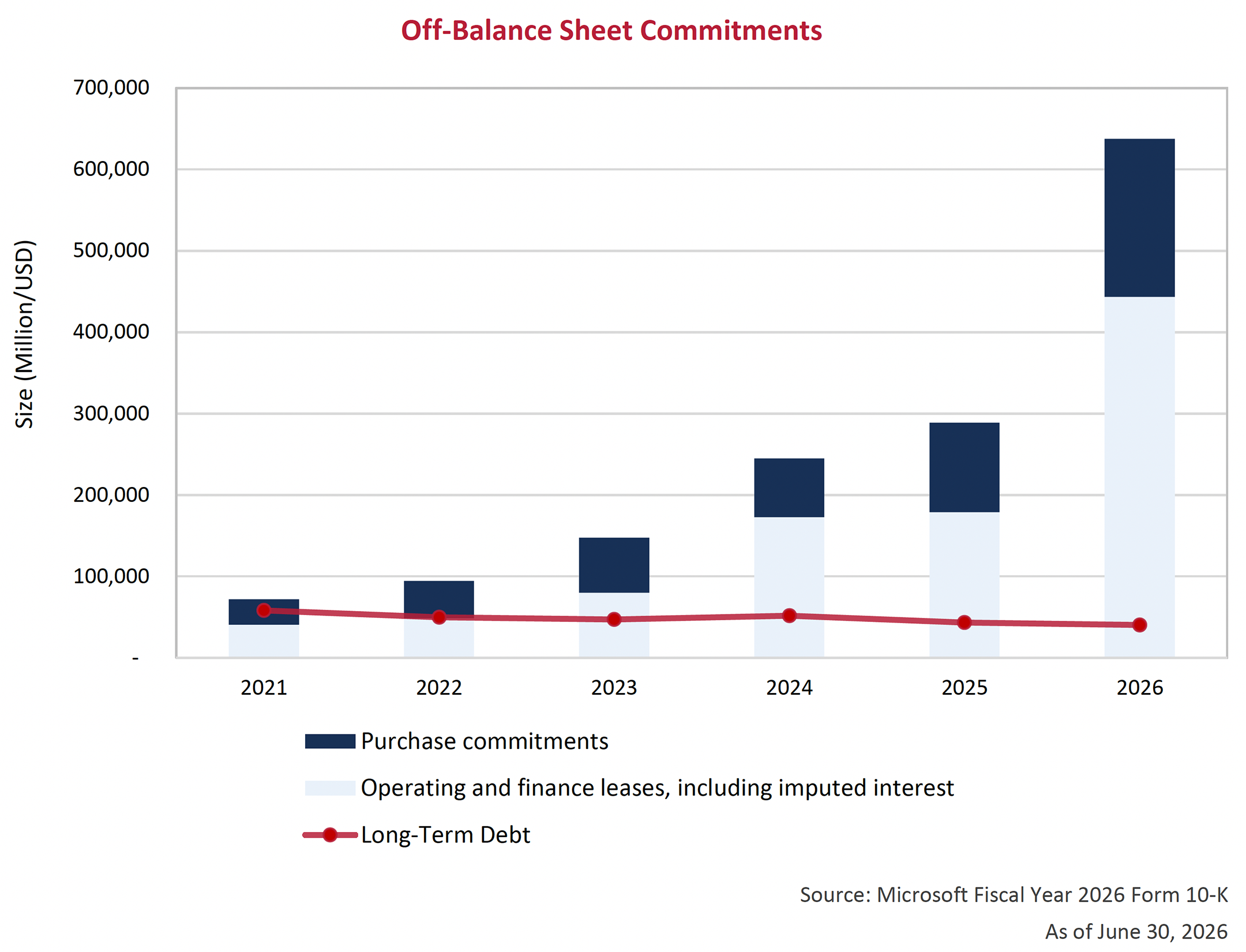
For example, looking solely at Microsoft’s balance sheet debt may understate the company’s true financial obligations. As shown in the chart below, purchase commitments and lease obligations have expanded substantially and now dwarf reported long-term debt, reflecting the scale of investments required to support continued growth in cloud computing and AI.
Keynes’s Marginal Efficiency of Capital
Keynes talked about an investment concept called the marginal efficiency of capital. Simply put it is the:
“rate of discount that would make the present value of the series of annuities given by the returns expected from the capital-asset during its life just equal to its supply price.” 1
As more investment is made in any type of capital, the marginal efficiency of that type of capital should decline. The concept is forward looking and is analyzing two things; the prospective yield of that investment and the supply price of that capital.
In the short-term, the pressure on facilities producing that capital causes its supply price to increase. When the gas pipeline used to fuel the data centre was denied a permit in New Mexico, the tenant Oracle Corp. invoked a force majeure. A force majeure clause refers to an unexpected event beyond anyone’s control that excuses parties from fulfilling their legal obligations. Oracle intends to save on paying rent to the project operators until the data centre is up and running. This is just one example of short-term production constraint. Data centres are also facing political backlash and rising construction costs related to labour and commodities.
In the long term, the prospective yields related to the investment become an issue. The output from the capital today will have to compete with the output from subsequent capital with arguably better technology. The economic life of chips is short, and their rapid obsolescence makes the next-gen chips better in terms of speed, size and heating. We can argue that a newer data centre will be more efficient than an older data centre.
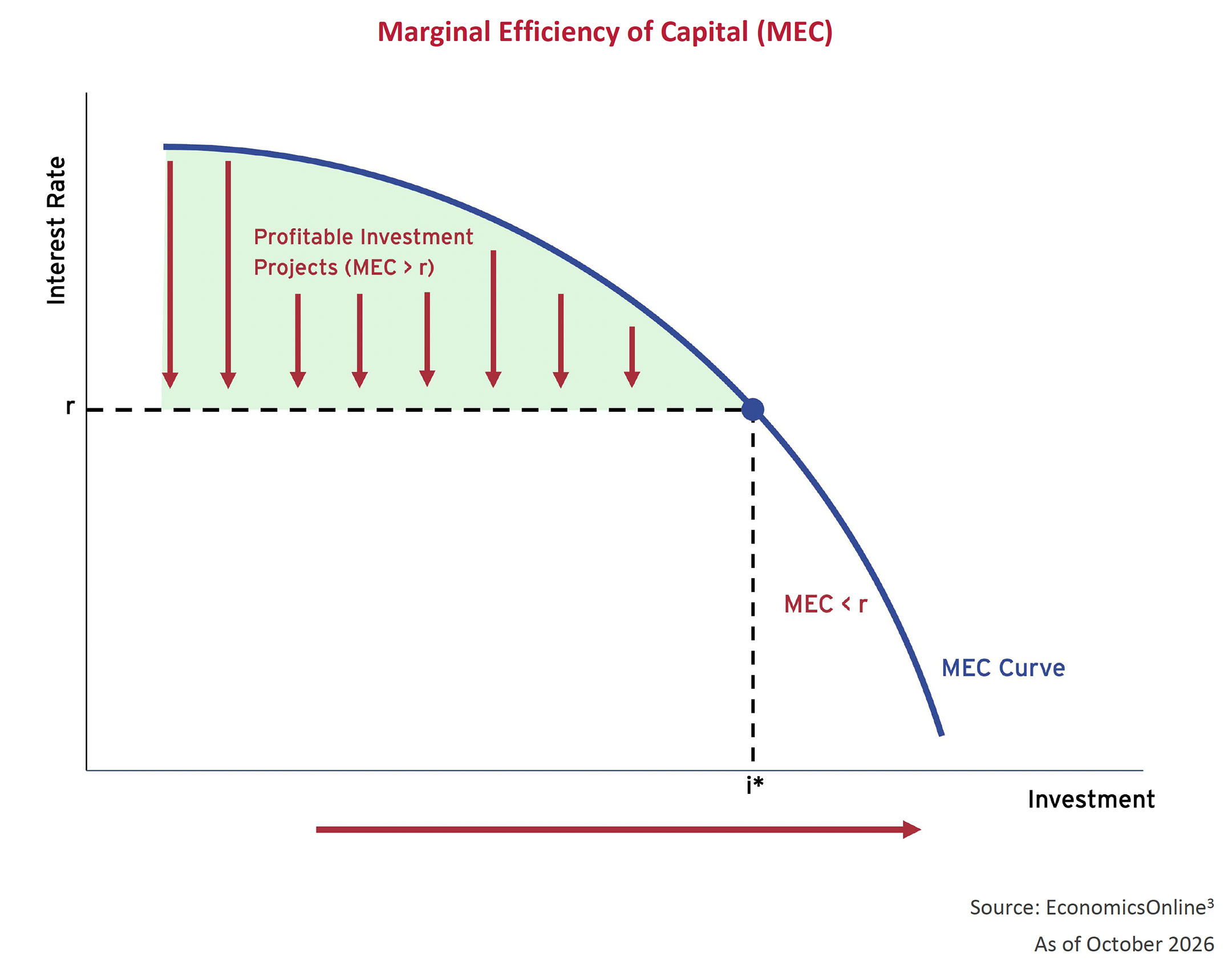
The expectation of a fall in the value of money stimulates investments and conversely a rise in the value of money lowers the marginal efficiency of capital. The hyperscalers because of their high credit ratings are price insensitive borrowers. However, when the off-balance sheet commitments appear on balance sheet, the outcome may be different.
According to Keynes, any long-term investment forecast depends on it being most probable and with the most confidence attached to it. He said,
“It would be foolish, in forming our expectations, to attach great weight to matters which are very uncertain.”1
We are also in the unsure camp related to AI demand. However, when we talk about hyperscalers and their animal spirits, we have to concede that it is their job to be optimistic. Again, quoting Keynes,
“if animal spirits are dimmed and the spontaneous optimism falters, leaving us to depend on nothing but a mathematical expectation, enterprise will fade and die.”1
There is so much requirement of capital for investment in AI that domestic savings are not enough. Hyperscalers are borrowing aggressively in global currencies and issuing at concessions relative to their pristine credit ratings. The cost of capital in such a scenario is expected to increase. The co-chief executive of Blue Owl Capital Inc., one of the larger investment firms, recently stated that the demand for computing power has exploded and it has become difficult to build data centres. Still seeking more money, he said,
“We are not managing enough capital.”4
“I am the House”
Japan is America’s biggest international creditor. The Japanese insurers and pensions have looked afar, mostly toward U.S. Treasuries to get higher yields. As inflation returns to Japan and yields rise, domestic bonds have suddenly become attractive to this class of Japanese investors. Another class of investor, global hedge funds, have historically borrowed cheaply in yen and invested the proceeds in higher-yielding securities globally. The reason this ‘yen carry trade’ was possible was because the Bank of Japan had kept interest rates below 1% since 1995. Fearing a disorderly unwinding of the yen carry trade, the U.S. and Japan intervened to support the yen, which was trading at a forty-year low. The U.S. Treasury’s purchase of the yen allowed Japan to buy less, and not liquidate their reserve holdings of Treasuries.
At the onset of the COVID-19 pandemic, central banks and companies outside the U.S. who had borrowed in USD found it hard to service the debt or pay for their imports in USD. The Federal Reserve had extended dollar swap lines to foreign central banks to allow them to overcome the funding issues. Japan used the Fed’s repo facility (also called the Foreign and International Monetary Authorities Repo Facility or FIMA Repo Facility) to intervene in the yen market and indicated that it will do the same in the future.
The U.S. Treasury Secretary Scott Bessent, a former hedge fund manager, confidently remarked to the currency traders,
“I have asymmetric information. I am the house now…You can bet against me if you want.”5
He also pressured the Fed to upsize the repo facility to Japan. Ironically, Bessent’s old firm had bet successfully against the British pound in 1992 and forced the British government to devalue the pound.
“Bloomberg Terminal Bros”
As U.S. long-term bond yields marched higher, Bessent made an even bolder move. He announced a plan to double the purchases of long-term Treasuries (later upsized to triple the usual amount of US$2 billion) to improve the smooth functioning of the bond market. Generally, the U.S. Treasury Department purchases older Treasuries considered ‘off-the-run’ to issue ‘on-the-run’ current coupon Treasuries. These buybacks are intended to maintain yields on less frequently traded Treasuries. We think Bessent’s intention is clear, to lower the yields on long-term government bonds. His boss, the U.S. President, has been persistent about lower bond yields. This is one of the reasons that the U.S. has primarily borrowed short-term.
A frustrated Bessent admitted to the actual reason for the long bond purchases,
“…the level of yields didn’t reflect underlying fundamentals…”6
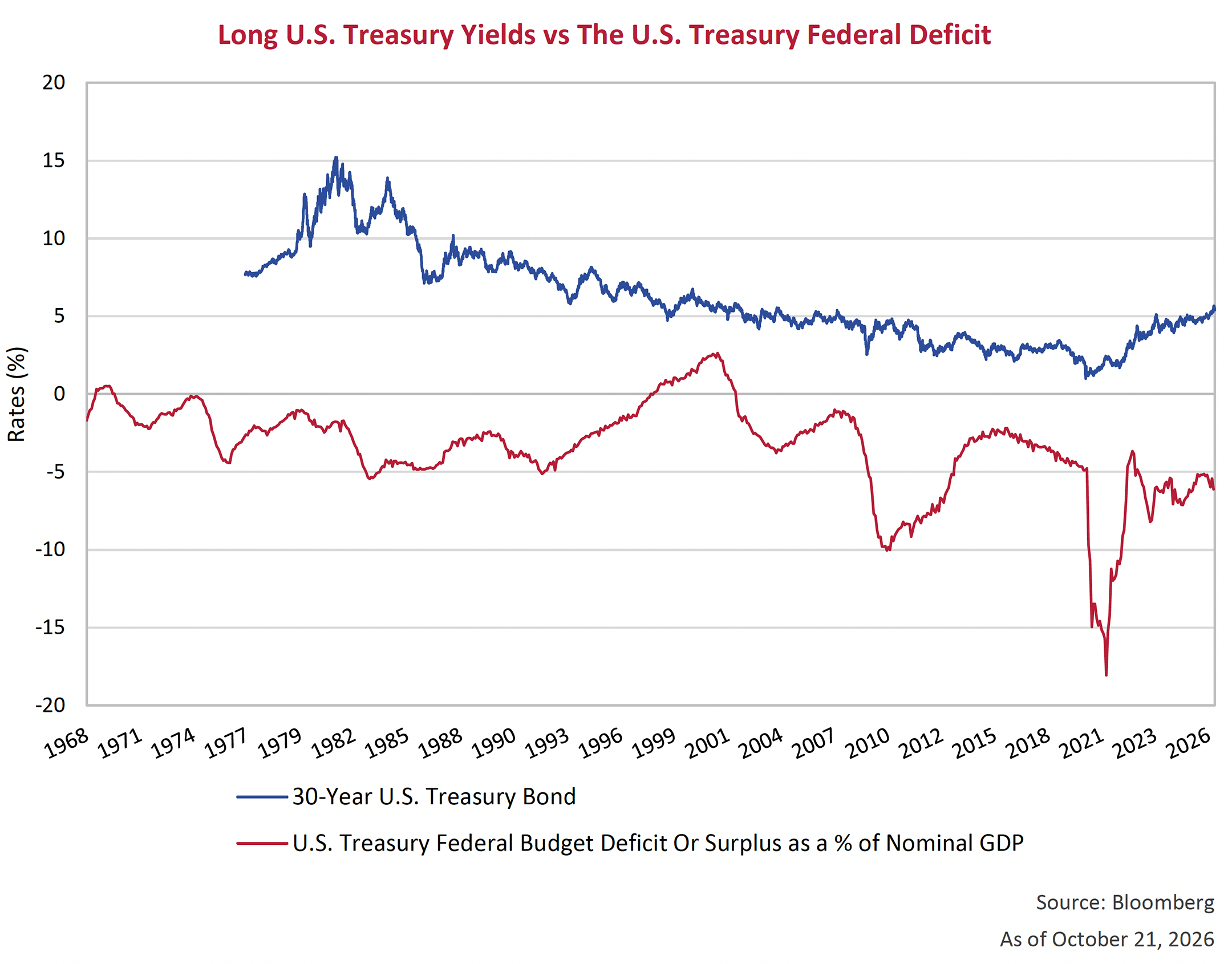
Bessent also went on to chide the “Bloomberg terminal bros,”7 referring to the bond trading community. We disagree with his assessment. The U.S. government deficits are very high, and inflation is nowhere close to the Federal Reserve’s target level. As can be seen from the chart below that despite reasonable economic growth, U.S. deficits are higher than 5% of Gross Domestic Product (GDP). This is one of the main reasons that long-term bond yields have crept toward 5.2%, the highest level in almost two decades.
Bessent’s former boss, Stanley Druckenmiller, who had orchestrated the British pound devaluation, was not pleased either. He wrote that,
“This wasn’t liquidity management, it was price management – and a mistake…”8
U.S. Mortgage-Backed Securities (MBS) also exacerbated the selling of Treasuries. American homeowners have the ability to prepay their mortgages anytime. As interest rates on mortgages have risen to multi-decade highs, homeowners have become reluctant to prepay their mortgage. Consequently, investors in MBS face a ‘negative convexity’ trade where their term extends as borrowers reduce prepayments and they are forced to sell Treasuries to manage their portfolio duration.
Despite the Treasury Department’s frantic moves, the U.S. borrowing costs have not come down. Recently, a contrite Bessent conceded that:
“the house doesn’t win every hand…”8
Situational Auction
In the well-chronicled history of over-levered hedge funds cornered into selling, another chapter was recently added. Published reports suggest the investment fund Situational Awareness was forced to sell their public stock portfolio at a concession to a better capitalized fund with prior experience in the dark art of “rescuing” over-levered funds.
As is often the case in finance, it’s never really different this time. Leading characters and asset names can be substituted, but the confluence of factors will always be the same. The script typically reads something like:
“Wizard portfolio manager(s) is given exceedingly high risk limits by banks competing to win business. Highly concentrated portfolio funded by short-term financing. Initially modest decrease in asset prices trigger immediate margin calls. Selling of concentrated positions inadvertently tips the market where selling is underway which in turn attracts short sellers. Manager reaches out to investors requesting more capital to post as margin in an attempt to avoid further selling. However, investors decline.”
The script could easily have been borrowed from the Long-Term Capital Management saga. Eventually a deep pocketed firm arrives on the scene to rescue them out of their “bad positions” i.e. anything exposed to daily mark-to-market fluctuations funded by debt. This is why they would have chosen to sell their portfolio of public stocks while holding on to their Anthropic stake. The rescue is expensive with reports indicating the purchasing fund bought Situational’s public stocks at a 10% discount to prices which were already down nearly 50% from the highs. Fortunately for Situational, its reported returns remain positive on the year, likely due to its position in soon to be IPO’d Anthropic.
Prime brokerage revenues pertaining to the financing of client equities positions are up dramatically this year for the largest Wall Street dealers. Situational Awareness is likely not the only fund using Wall Street financing to go all in on AI positions. We think conditions are ripe for further leverage-induced crises ahead.
Macklem’s Move?
The Bank of Canada (BoC) is set to meet this week to announce its overnight rate decision. This will be the penultimate decision of 2026, with the final to be made early December.
The BoC has held its rate steady at 2.25% for the past year after spending the previous 18 months bringing the overnight rate down from the post-COVID-19 runup to 5%. The market is currently pricing an 80% probability the BoC will hike 25 basis points (bps).
The chart below graphs 2-Year Government of Canada (GoC) Notes versus 2-Year U.S. Treasury Notes (UST). As depicted, the 2-Year GoC has outperformed the 2-Year UST by 45 bps year-to-date under the narrative that the Canadian economy is susceptible to turbulence as it navigates a trade war with its southern neighbour which would point to an accommodative BoC.
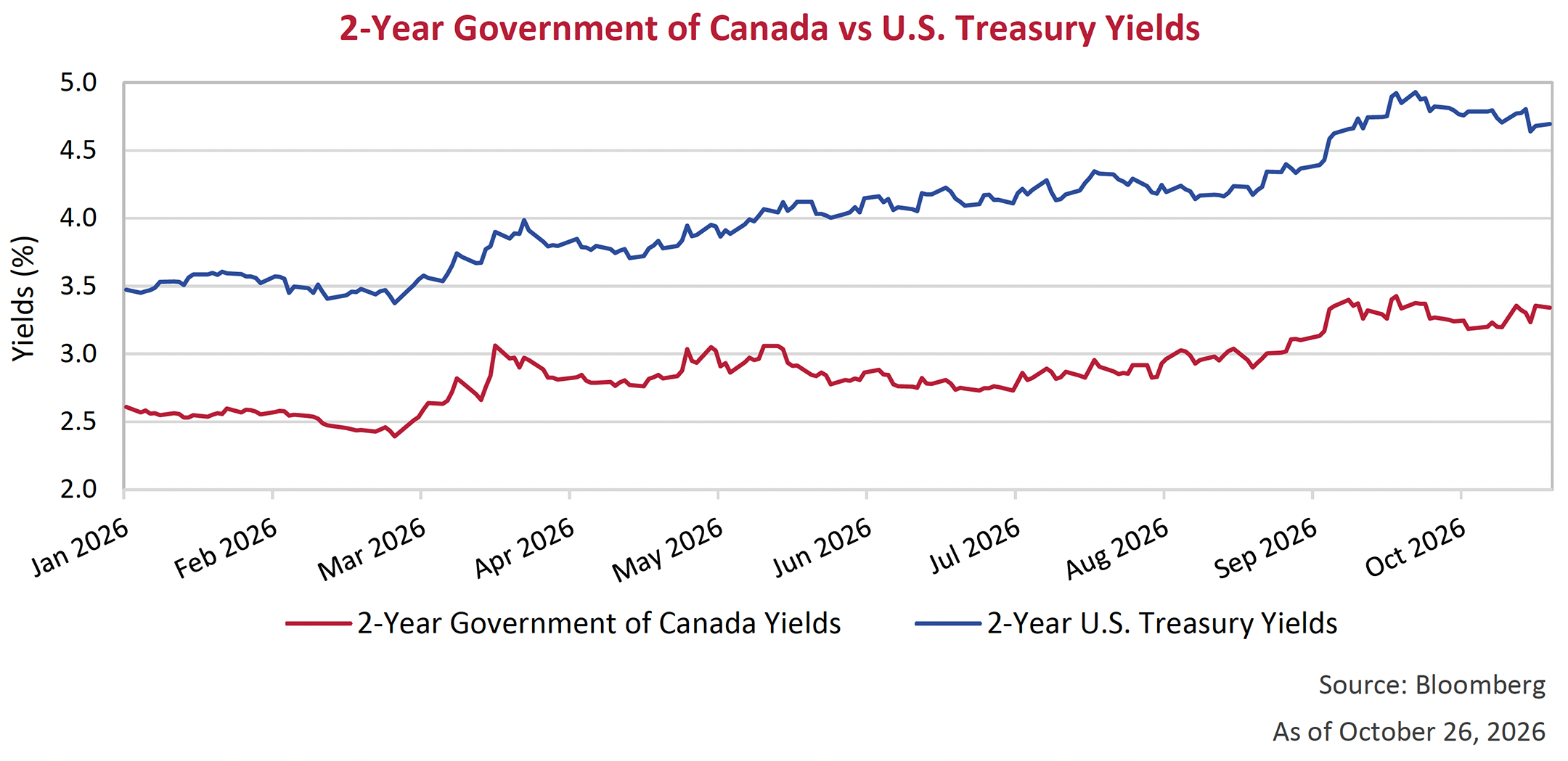
However, while the Canadian headline (Consumer Price Index) CPI year-over-year increase of 3.1% trails the corresponding U.S. measure by 0.6%, it now sits slightly above the target range. While the increase is driven by fuel prices which in theory could revert lower, the BoC’s concern is that the longer fuel prices remain elevated, the greater the likelihood these costs will seep into the price of broader goods.
The next chart shows the spread difference between 2-Year GoC yields and the Bank of Canada Overnight Rate. As shown, for approximately the decade post-Great Financial Crisis (GFC), the spread was minimal, ranging between 0% and 0.50%. Even through the first 18 months of COVID-19, the spread was effectively zero, as the 2-Year rallied to 0.25% and the BoC immediately cut its rate to the same level. Then in Q4 of 2021 and Q1 of 2022, the spread erupted as the market signaled that the BoC was behind on controlling inflation and needed to begin hiking up from the overly accommodative rate still at 0.25%.
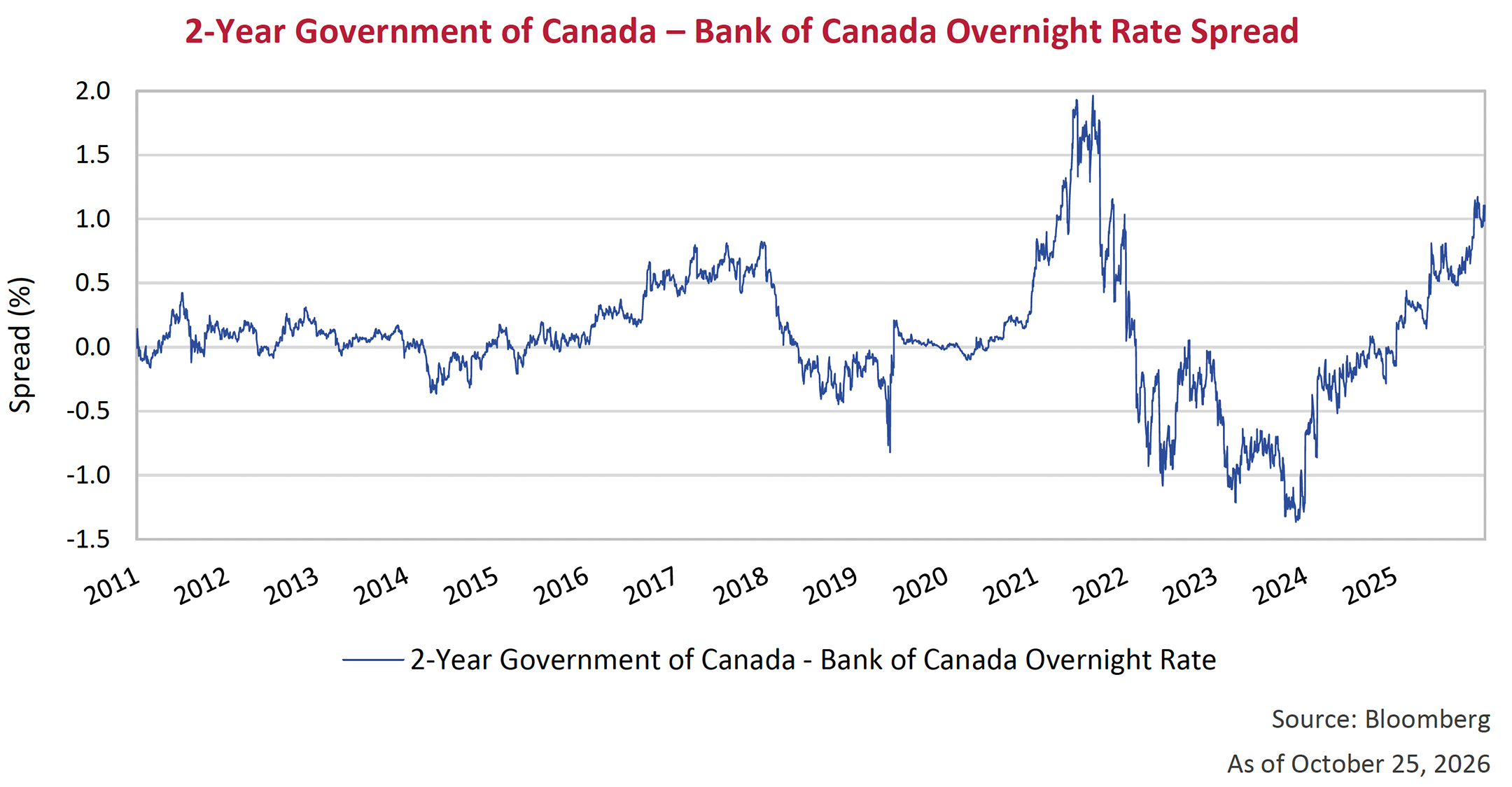
The spread has risen another 0.75% over the past 2 months and now sits at 1.10%. The market clearly believes the BoC will not be able to err on the side of accommodation as a hedge against trade war damage. Given there does not appear to be any pending truce to reopen the Strait of Hormuz prior to the midterms, we believe the BoC will be cautious but ultimately will tighten rates to a limited degree.
Enthusiasm vs Reality
The question is not whether AI or monetary policy will shape the future, but whether the expectations embedded in today’s markets accurately reflect the realities that will eventually emerge. Innovation and risk-taking have always been essential drivers of progress. However, history suggests that when enthusiasm and leverage run ahead of economic fundamentals, markets ultimately reconcile expectations with reality. When these conditions converge, Canso will deploy our funds’ liquid reserves at yields which price risk appropriately.
Footnotes
- Source: Keynes, John Maynard. (1936, February) The General Theory of Employment, Interest, and Money.
- Source: Güldoğan, Diyar. (2026, September 30) Anthropic CEO highlights AI’s benefits and risks after White House meeting.
- Source: Ansari, Saddique. (2026, August 20) Marginal Efficiency of Capital: Definition and How It Works.
- Source: Fontanella-Khan, James et al. (2026, October 7) Blue Owl to launch ‘big push’ into insurance.
- Source: Timiraos, Nick. (2026, August 3) Why Bessent Is Leaning on the Fed to Help Prop Up Japan’s Currency.
- Source: Goldfarb, Sam. (2026, August 19) Bessent Leans Into His Role as America’s Bond Trader in Chief.
- Source: Pringle, Eleanor. (2026, September 11) ‘If the Bloomberg Terminal bros are unhappy with what I’m doing, that’s too bad’: Bessent says he’ll continue ‘ignoring the noise’
- Source: Druckenmiller, Stanley F. (2026, August 24) Let the Bond Market Speak.
- Source: Rappeport, Alan. (2026, October 4) Rebuked by Bond Market, Bessent Says ‘House’ Does Not Always Win.
